
Recording Lectures and Turning Them into Study Notes: AI Support for Students
13 settembre 2026
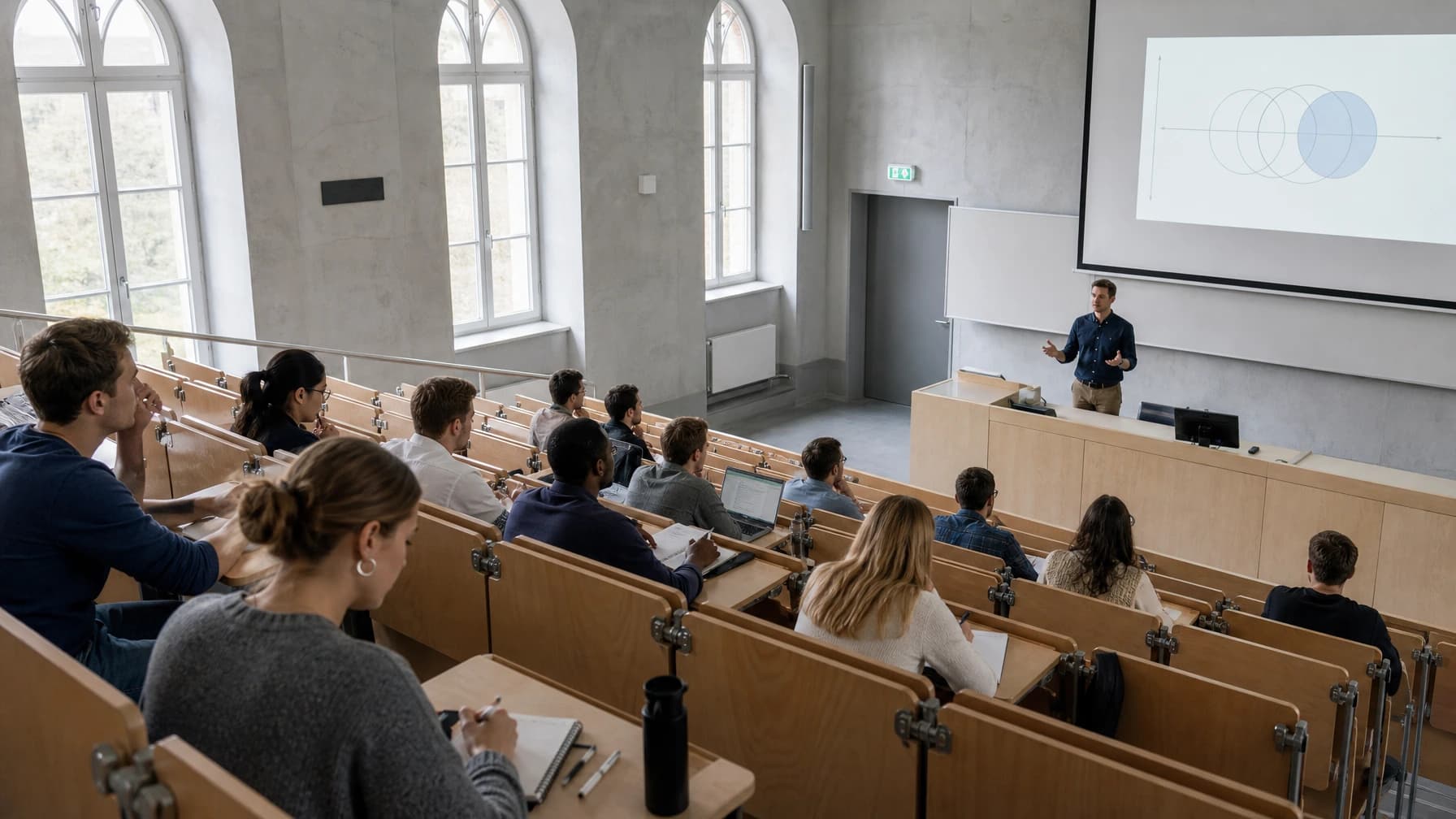
At a Glance
- For: Students reviewing lectures or preparing for exams
- Problem: Taking notes and truly listening at the same time rarely works well
- Solution: Ponora note records, transcribes, and automatically creates study notes plus a mind map
- Important: Only record with the lecturer's consent
Taking notes while actually understanding what's being explained — for many students, that's a constant balancing act. Focus on the notes, and you often lose the thread of the explanation. Focus on listening, and you're left with nothing to review afterward. AI-powered recording and transcription tools solve exactly this dilemma: the lecture is captured in full while you listen, think, and ask questions — and the structured notes appear automatically afterward.
The core problem with traditional lecture notes
Handwritten notes are selective: you write down what seems important in the moment — and often miss exactly the side remarks that turn out to matter for the exam. On top of that, notes are rarely well-structured right after a lecture; many students spend extra hours turning their own notes into something they can actually study from.
How Ponora note turns a lecture into study material
The process is refreshingly simple:
- Record — The device captures the lecture unobtrusively, whether in a lecture hall or an online seminar.
- Sync — After the lecture, the recording automatically syncs with the app.
- Transcribe — The AI produces a complete, searchable transcript of the entire lecture.
- Structure — The transcript is automatically turned into summaries and, depending on the plan, even mind maps that visually show key terms and how they relate.
The mind map feature in particular is a real help for visual learners: instead of a wall of text, you get an overview that shows how topic blocks connect at a glance — a genuine advantage when preparing for exams.
Want to give it a try? Start free with Ponora note →
Three situations where this really pays off
Dense subject-matter lectures. In content-heavy fields — law, medicine, or the natural sciences, for example — you can re-listen to or re-read any passage afterward, instead of relying on a one-shot, incomplete set of notes.
Missed lectures. If you're sick or can't make it to a session, a recording (with consent — see below) means you don't fall behind, unlike relying on a classmate's incomplete notes.
Exam preparation. Searchable transcripts across multiple lectures can be searched by keyword — considerably faster than flipping through binders full of handwritten notes.
Legal note: get consent first
Recording lectures and seminars isn't automatically allowed everywhere. In Germany, as a rule, a recording may only be made with the consent of the person being recorded — in this case, typically the lecturer. Many universities also have their own policies on lecture recordings. Students should therefore actively ask and get the instructor's consent beforehand, rather than assuming silent tolerance is enough. The same logic applies wherever you study: check your institution's policy and ask the instructor directly.
Privacy when learning with AI
Since lecture content often includes copyrighted teaching material and personal speech data belonging to the instructor, GDPR-compliant processing matters in an educational context too. Ponora, as a German company, processes data primarily on European infrastructure, aligned with GDPR requirements.
Frequently asked questions about recording lectures
Can I just record a lecture? No — as a rule, you need the lecturer's consent, since it involves recording their spoken words. Many universities also have their own policies on lecture recordings that students should check beforehand.
How does an audio recording turn into study notes? The AI first transcribes the recording completely, then creates a structured summary of the key points — on eligible plans, supplemented by a visual mind map of how topics connect.
Does this work for online lectures or video seminars too? Yes, the principle works regardless of whether the lecture happens in a hall or online — what matters is simply that an audio recording of the spoken content exists.
What does it cost for students? Ponora offers a free entry-level plan with a limited monthly transcription volume. For regular use across multiple lectures and courses, a paid plan with more minutes and storage is usually worth it.
Can I search my notes for a specific term? Yes — since the entire lecture exists as searchable text, full-text search lets you find exactly where a given term or topic was discussed.
Conclusion: Listen instead of scrambling to write
An AI recorder removes the need for students to choose between listening and taking notes — both become possible at once, since documentation happens automatically. With the instructor's consent, every lecture turns into complete, searchable study material that noticeably eases exam prep.
Start for free and turn your next lecture into study notes: Explore Ponora note